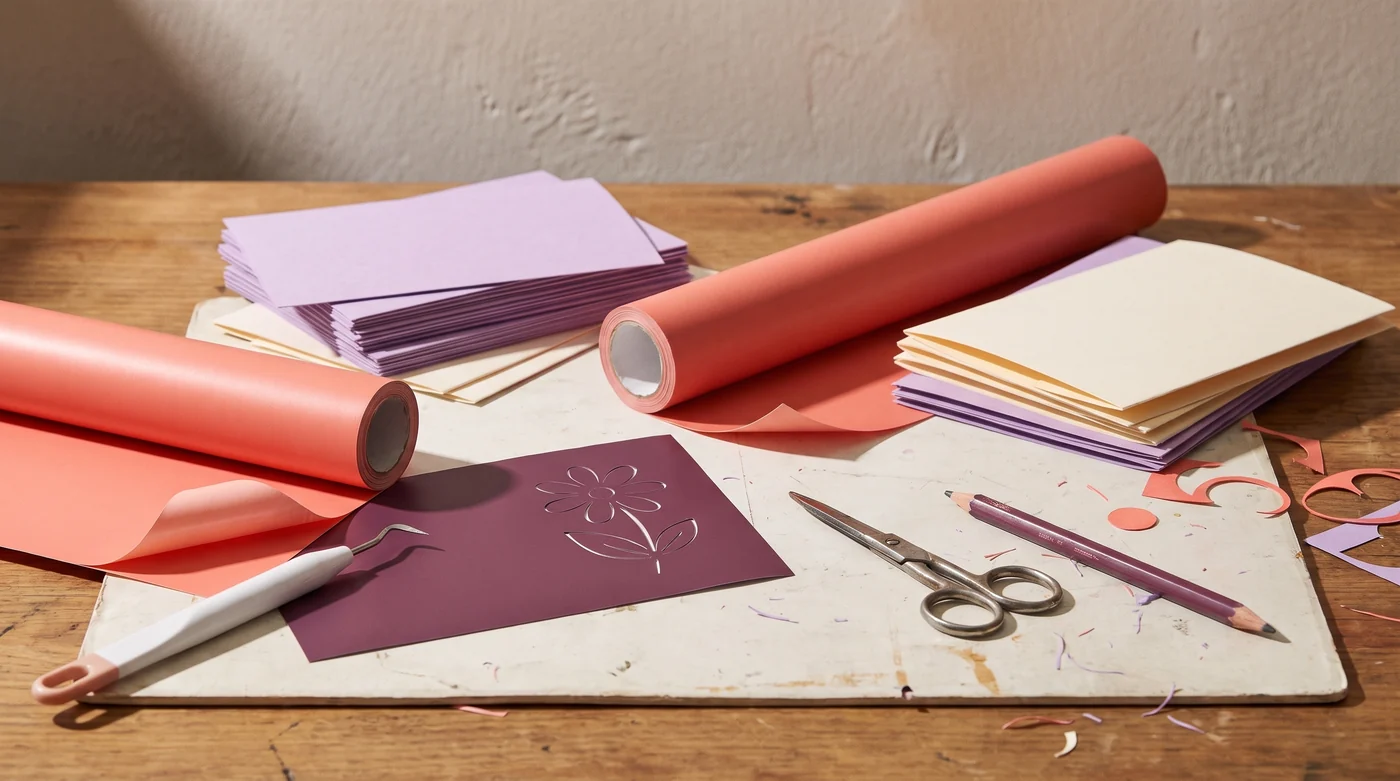
Plan the fold, score and cut around the exact stock you have.
- Finished object
- Sheet & grain
- Score or test cut
- Assemble sample
What to check & keep in mind
- Thickness or weight stated by supplier
- Coating and print compatibility
- Fold quality on a sample
The same paper weight can behave differently across finishes and constructions.
Continue into the subject ↗A cut design needs a suitable surface and a transfer method as well as a material color.
- Surface & use
- Material instructions
- Small cut & transfer
- Care after application
What to check & keep in mind
- Compatible surface
- Transfer-tape suitability
- Removal and care instructions
A removable or permanent label does not establish suitability for every surface.
Continue into the subject ↗Keep the transfer material, base fabric and heat instructions together.
- Blank material
- Product instructions
- Orientation & test
- Press and peel as specified
What to check & keep in mind
- Exact heat settings
- Liner orientation
- Care and wash instructions
Do not apply one temperature and peel rule to all transfer materials.
Continue into the subject ↗Printable products can use different printing and orientation rules from cut iron-on.
- Printer compatibility
- Correct print side
- Check orientation
- Apply documented process
What to check & keep in mind
- Light or dark fabric variant
- Ink and printer requirements
- Product-specific mirroring rule
Some printable iron-on instructions say not to mirror; inspect the exact product.
Continue into the subject ↗Let the pattern guide the fabric and keep direction and seam allowance visible.
- Pattern & size
- Fabric direction
- Practice seam
- Cut with allowances
What to check & keep in mind
- Usable fabric width
- Pattern repeat or directional print
- Pre-treatment required by pattern
Rotating a pattern piece can change the grain or print direction.
Continue into the subject ↗Match the fabric, support and stitch scale before beginning the final piece.
- Design scale
- Fabric & support
- Sample stitches
- Finish and inspect
What to check & keep in mind
- Needle and thread suitability
- Tension and puckering
- Hoop or stabilizer requirements
A visually neat first stitch is not proof the whole design will remain flat.
Continue into the subject ↗